Q1. (i) A multiplexer combines five 25-Kbps (see Figure 1) data streams. Each output frame is 20 bits long.
a) Draw a diagram showing the contents of the first two frames of the output with the five inputs as shown in the figure. In your diagram, indentify the bits of each channel.
• The bits enter the mux from right to left
• Refer to lecture slides to see how the output frames should look]
b) What is the frame rate and the frame period?
c) What is the bit rate from the output of the MUX?

Q2.
(i) Suppose that frames are 500 bytes long which includes 58 bytes of overhead. Also assume that ACK frames are 64 bytes long.
a) Calculate the efficiency of Stop-and-Wait ARQ in a system that transmits at R=1 Mbps and reaction time 2(Tprop + Tproc) of the following: 1ms, 10ms, 100ms, and 1 second.
b) Repeat if R=1 Gbps.
(ii) Three ARQ protocols are discussed in this course. Discuss what actions each ARQ protocol takes when it detects a frame with errors?
(iii) In a Stop-and-Wait ARQ system, the bandwidth of the line is 64kbps, and 1 bit takes 100 ms to make a round trip.
a) What is the bandwidth-delay product?
b) If the system data frames are 128 bytes in length, what is the utilization percentage of the link?
c) What is the utilization percentage of the link if the link uses Go-Back-N ARQ with a 4-frame sequence?
Q3. (i) Explain how these two persistence strategies work;
1. Non-Persistence
2. p-Persistence
(ii) Explain the advantages of each strategy.
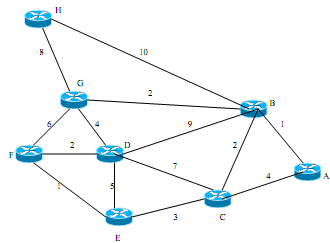
Q4. Consider the network shown in Figure 2.;
a) Using Dijkstra's algorithm, compute the shortest paths from A to all network nodes showing your work using tables.
b) Using Bellman-Ford algorithm, compute the shortest paths from B to all network nodes showing your work using tables.
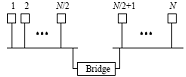
Q5. Suppose N stations are connected to an extended Ethernet LAN, as shown below shown in Figure 3, operating at the rate of 100 Mbps. Assume that the efficiency of each Ethernet is 30 percent. Also assume that each station transmits frames at the average rate of R bps, and each frame is equally likely to be destined to any station (including to itself).
a) What is the maximum number of stations, N, that can be supported if R is equal to 100 kbps?
b) If the bridge is replaced with a repeater, what is the maximum number of stations that can be supported?
Q6.
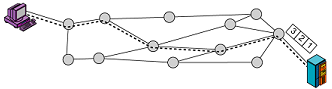
Suppose there are exactly five packet switches between a sending host and a receiving host connected by a virtual circuit line (shown as dotted line in figure 4).
The transmission rates between the various network elements are as follows:
Between sending host and the 1st switch the rate is 2R1;
Between the 1st and the 2nd switch the rate is 3R2;
Between the 2nd and the 3rd switch the rate is R3.
Between the 3rd and the 4th switch the rate is 3R2;
Between the 4th and the 5th switch the rate is R1;
Between the 5th and the receiving host the rate is R1;
What is the total end-to-end delay to send a packet of length 2L bits? (Ignore queuing, propagation delay, and processing delay.) Show your working.
Q6.
THIS IS AN EXPLORITORY QUESTION.
Recall that ATM uses 53-byte packets consisting of five header bytes and 48 payload bytes. 53 bytes is unusually small for fixed-length packets; most networking protocols (IP, Ethernet, Frame Relay etc.) use packets that are, on average, significantly larger. One of the drawbacks of a small packet size is that a large fraction of link bandwidth is consumed by overhead bytes; in case of ATM, almost 10% of the bandwidth is "wasted" by the ATM header. In this problem, we investigate why such a small packet size was chosen.
Specifically, we want to compare the Packetisation Delay and Transmission Delay of small packets to that of large packets. In Part a) you
derive a general formula for Packetisation Delay, so we can use it to calculate the Packetisation Delay of any packet L bytes long.
Next you use this formula to calculate the Packetisation Delay for two specific cases. In the third part, you calculate Transmission Delay for the each of these cases.
Finally, you are required to make a comment about using small and large packet sizes, using the results of your investigation as evidence.
(i) Consider sending a digitally encoded voice source. Suppose the source is encoded at a constant rate of 64 kbps. We use these bits to fill the data payload of a packet or cell. Each packet is entirely filled before it is sent into the network. The time required to fill a packet or cell is called the Packetisation Delay.
In this question, you are required to derive a formula for the Packetisation Delay. To ensure we can use it to calculate the
Packetisation Delay for a packet or cell of any size, just use the letter
"L" to represent the packet size in bytes
Be sure to adjust your formula so that Packetisation Delay is in milliseconds.
(ii) An important parameter when discussing Quality of Service is the user experience of the line. It has been found that Packetisation Delays greater than 20 mS can cause a noticeable and unpleasant echo.
Use your formula from Part (i) to determine the Packetisation Delay for:
a) L=1,500 bytes (roughly corresponding to a maximum-sized Ethernet packet)
b) L=50 (roughly corresponding to an ATM cell).
(iii) Calculate the Transmission Delay for a link rate of R=155 Mbps (a standard ATM data rate) for:
a) L=1500 bytes
b) L=50 bytes.
(iv) Review the results of your calculations and consider the impact these two delays have on the quality of service. As a result of your work, comment on the use of the small cell size used in ATM. Refer to your results to support your position.