Ask Electrical & Electronics Expert

problem 1: Simplify the block diagram shown in figure below and obtain the overall transfer function. (You have to use various commands in MATLAB that will help to simplify)
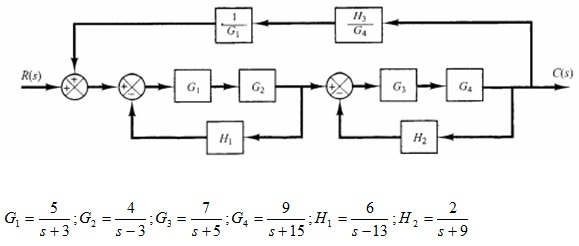
1387_transfer function.jpg

problem 2: The system model for the DC motor shown in figure below, is given by:
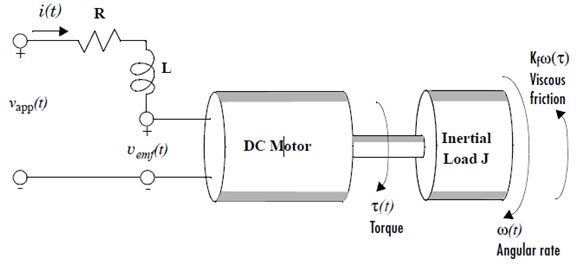
553_DC motor.jpg

This system can be described by the following differential equations.
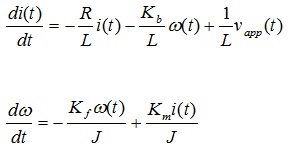
699_differential equations.jpg

Assume the following constants for a typical DC motor:

L = 0.5 H
Km = 0.015
Kb = 0.015
Kf = 0.02
J = 0.02
R = 2 Ω

a) Find the transfer function of the system.
b) Plot the step response and hence determine the rise time, settling time, peak time, maximum overshoot and steady-state error.
c) Plot the impulse and ramp response of the system.
d) Sketch the Bode plot for the system

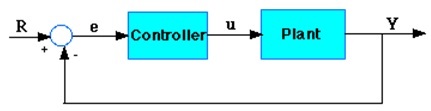
problem 3: A system’s performance can be improved by adding a controller and feedback as shown in the figuer below.The controller transfer function can be designed to obtain a desired response. Assuming the plant to be the DC motor given in problem 2, Plot the overall response of the system for the following controllers. The controller constants are to be designed based on the fast response criteria (short settling time).

a) Proportional
b) PI
c) PD
d) PID
e) Find the poles and zeros of the system in each case.
f) Comment on the obtained results.
548_response criteria.jpg

problem 4: Plot the root-locus for a system whose open-loop transfer function is given by:

G(S) = K(s + 3)/[(s2 + 3s + 4)(s2 + 2s + 7)]

problem 5: The open-loop transfer function of a unity feedback control system is given by:

G(s) = 1/[s(s+2)(0.6s +1)]

The performance of the system is improved by using a compensator in the forward loop whose transfer function is given by:

Gc(s) = [10(10s + 1)]/[100s + 1]

a) Co-plot the step response of the uncompensated and compensated systems and comment on the results.

b) Co-plot the ramp response of the uncompensated and compensated systems and comment on the results.

c) The compensator was designed to improve the phase margin to atleast 50 degrees and the gain margin to atleast 10 dB, show by plotting the frequency response that the compensator satisfies the design criteria.

d) Sketch the poles and zeores of the uncompensated and compensated systems and comment on the stability.

Electrical & Electronics, Engineering

  • Category:- Electrical & Electronics
  • Reference No.:- M9970
  • Price:- $90

Guranteed 48 Hours Delivery, In Price:- $90

Have any Question?


Related Questions in Electrical & Electronics

Question 1for the ce amplifier in figure 1 given the

Question 1 For the CE amplifier in Figure (1), given the following component parameters: Parameter Value β DC , β AC 150 V BE 0 . 7 V V CC 12 V R C 820 ? R E 1 100 ? R E 2 220 ? R 1 20 k? R 2 5 . 2 k? R L 100 k? C 1 , C ...

Question -i a star-connected three-phase synchronous

Question - (i) A star-connected, three-phase synchronous induction motor takes a current of 10 amps from a 415 volt supply at unity power factor when supplying a steady load. If the synchronous reactance is 5 ohms/phase ...

1 a name the three major groups of contamination and

1. (a) Name the three major groups of contamination and briefly describe their physical characteristics. (b) Where do the above contamination types come from? Give one example of each. 2. Name two processes metrics which ...

Question 1 in the voltage regulator circuit in figure p221

Question 1: In the voltage regulator circuit in Figure P2.21, V 1 = 20 V, V Z = 10 V, R i = 222Ω and P z (max) = 400 mW. (a) Determine I L, I z , and I L , if R L = 380Ω. (b) Determine the value of R L , that will establ ...

Summative assessmentin 2017 sej101 assessment will consist

Summative Assessment In 2017 SEJ101 assessment will consist of nine tasks that will develop a portfolio of your assessed work. Throughout the trimester you will have the opportunity for feedback on all nine tasks before ...

1 a name the three major groups of contamination and

1. (a) Name the three major groups of contamination and briefly describe their physical characteristics. (b) Where do the above contamination types come from? Give one example of each. 2. Name two processes metrics which ...

1 a name the three major groups of contamination and

1. (a) Name the three major groups of contamination and briefly describe their physical characteristics. (b) Where do the above contamination types come from? Give one example of each. 2. Name two processes metrics which ...

Case studythis assignment consists of a written report of

CASE STUDY This assignment consists of a written report of approximately 1000 words and any diagrams in which you are asked to critically compare different process methods used to achieve the same result and show an awar ...

Problem 1 a two-phase servomotor has rated voltage applied

Problem 1: A two-phase servomotor has rated voltage applied to its excitation winding. The torque speed characteristic of the motor with Vc = 220 V, 60 Hz applied to its control phase winding is shown in Fig.1. The momen ...

Electrical engineering questions -q1 two ideal voltage

Electrical Engineering Questions - Q1. Two ideal voltage sources designated as machines 1 and 2 are connected, as shown in the figure below. Given E 1 = 65∠0 o V, E 2 = 65∠30 o V, Z = 3Ω. Determine if Machine 1 is genera ...

  • 4,153,160 Questions Asked
  • 13,132 Experts
  • 2,558,936 Questions Answered

Ask Experts for help!!

Looking for Assignment Help?

Start excelling in your Courses, Get help with Assignment

Write us your full requirement for evaluation and you will receive response within 20 minutes turnaround time.

Ask Now Help with Problems, Get a Best Answer

Why might a bank avoid the use of interest rate swaps even

Why might a bank avoid the use of interest rate swaps, even when the institution is exposed to significant interest rate

Describe the difference between zero coupon bonds and

Describe the difference between zero coupon bonds and coupon bonds. Under what conditions will a coupon bond sell at a p

Compute the present value of an annuity of 880 per year

Compute the present value of an annuity of $ 880 per year for 16 years, given a discount rate of 6 percent per annum. As

Compute the present value of an 1150 payment made in ten

Compute the present value of an $1,150 payment made in ten years when the discount rate is 12 percent. (Do not round int

Compute the present value of an annuity of 699 per year

Compute the present value of an annuity of $ 699 per year for 19 years, given a discount rate of 6 percent per annum. As