Project: Dynamic modelling and Analysis
Project Details
Your project is to analyse the performance of a quad bike similar to the one shown in Figure 1. You are to analyse the quad bike as a mechanical system using mathematical modelling and vibration analysis. You will also have to consider riders of different masses and different payloads weights that the bike may be used to carry. You will be asked to analyse this same system in Project 2 with increased degrees of freedom and application of control.
Table 1 shows the basic specifications to be used. Any assumptions or additional information you use should be clearly stated and justified. It is recognised you may not have all the information you require but any values you assume should be within believable levels.
Your report will include:
- Specifications of suitable suspension parameters: stiffness and damping. Based on initial research and speculations of quad bike use. The design should also be informed by an iterative process and based on your analysis
- An evaluation of the quad bike's suspension performance, vibrations and transients.
- Addressing of all the Reflection and Discussion points
- Also see the assessment criteria at the end of this document to check you have included everything you need in the report
Table 1: Quad Bike Specifications (Yamaha Australia 2018)
|
Engine:
|
708cc, DOHC, four-stroke, single cylinder,
liquid-cooled
|
|
Transmission:
|
Ultramatic V-belt
|
|
Chassis- Dimensions:
|
|
|
Overall Length:
|
2070mm
|
|
Overall Width:
|
1230mm
|
|
Overall Height:
|
1253mm
|
|
Tires/Front:
|
AT 26 x 8-12
|
|
Tires/Rear:
|
AT 26 x 10-12
|
|
Suspension Front:
|
Independent double wishbone, 193mm travel
|
|
Suspension Rear:
|
Independent double wishbone, 232mm travel
|
|
Seat Height:
|
918mm
|
|
Wheelbase:
|
1250mm
|
|
Ground Clearance:
|
288mm
|
|
Fuel Capacity:
|
18 litre
|
|
Wet Weight:
|
314kg
|
PART A: Problem Scope, Assumptions and Limitations
State and justify the assumptions you make of the Quad bike expected use, payload details and variations (i.e. rider mass, payload mass, location, mass variations, and road variations). Use these variations in each of the following analysis where appropriate.
State any analysis your report does not cover but could have been done if a larger analysis was required and more time and information was available.
Make an estimate of the tyre properties, do not spend a lot of time getting ‘good numbers' it is your analysis that is important. State clearly how you obtain this, you may use experimentation, measurement of existing tyre deflection on vehicle of known mass. Accuracy is less important than your approach, however, ensure your estimates are within a sensible range. You may wish to consider a range of tyre properties based on varying tyre pressures that are used for the quad bike tyres specified in Table 1.
PART B: Single Degree of Freedom
For this part your analysis is to be limited to treating the quad bike as dynamic system with a single degree of freedom. This will help with the aim to determine suitable suspension stiffness and damping, vary these through the analysis to see the effect and to determine the best combination.
Your analysis will include the points below (include and compare different types of analysis using vibration equations, Matlab and Simulink where appropriate). Explain your working and models so an engineer could understand your process, results and findings of each point. Use each analysis point to help in the main aim described in Section 2.0.
Draw a mathematical model schematic of the quad bike.
Simplify the system to a single degree of freedom system (vertical motion only -Assume there is no roll or pitch.).
Draw the 1 DOF free body diagram and write the modelling equation.
Analyse the free vibration response for the expected variations in Part A.
Analyse forced vibration. Assume a small imbalance occurs in the engine.
Analyse surface induced vibration analysis. Assume road speeds from 0kph to 50kph. Assume a simplified corrugation shape (e.g. a sine wave) and a set of realistic road corrugation depths and wavelengths.
Determine under what conditions resonance may occur and the magnitude effect on the bike.
Produce suitable plots of magnification factor and transmissibility factor to help with the analysis points above.
Determine suitable Laplace transforms of the modelling equation. From this equation develop a transfer function describing the system. Also examine Stability criteria and produce a Bode plot for the system. Compare with your Bode diagrams with plots of magnification factor and transmissibility factor.
Model the system in Simulink and repeat the analysis points (B.4 to B.9). Compare the Simulink results with the theoretical calculations and explain any differences (also use this to check your results, and to show if you need to correct either your analysis or your models)
Add non-linearities to the spring mass model in Simulink to make it more reflective of the real situation [Keep the model as a single DOF]. Demonstrate the non-linearities behave as expected. Repeat the analysis points above where suitable and compare with your previous results. Draw some conclusions from your comparison.
In a conclusion to Part B, state the best suspension stiffness and damping found and summarise your key findings and observations. The findings in this part will be a good starting point for the next parts.
Part C: Two Degree of Freedom - Vertical Two Mass
Part C is to improve the model you developed in Part B and again analyse the dynamic performance with the aim to determine more suitable suspension stiffness and damping values.
The first improvement in the model to be evaluated will be inclusion of the unsprung mass of the wheels, axles and the stiffness of the tyres.
As before your analysis will include the points below (include and compare different types of analysis using vibration equations, Matlab and Simulink where appropriate). Explain your working and models so an engineer could understand your process, results and findings of each point. Use each analysis point to help in the main aim presented in Section 2.
Simplify the quad bike system to a two degree of freedom system (two masses, vertical motion only-Assume there is no roll or pitch).
Draw the simplified model schematic and the 2DOF FBD and write the modelling equations.
From these equations using calculations or Matlab determine the free undamped resonance frequencies and mode shapes. Discuss the meaning of the results with respect to your aim to analysis of the quad bike.
Create a suitable 2DOF Simulink Model to also confirm the results above.
Using the 2DOF Simulink model, analyse road surface induced vibration. Assume road speeds from 0kph to 50 kph. Assume a simplified corrugation shape and a set of realistic road corrugation depths and wavelengths.
Create suitable damped transfer functions and use Matlab scripts to create bode plots for the damped system undergoing road surface induced vibration.
Add non-linearities to the spring mass model in Simulink to make it more reflective of the real situation [Keep the model as a two DOF system]. Demonstrate the non-linearities behave as expected. Repeat the previous road surface analysis and compare with your previous results. Draw some conclusions from your comparison.
In a conclusion to Part C, state the best suspension stiffness and damping found and summarise your key findings and observations.
Part D: Two Degree of Freedom - Vertical and Pitch
Part D is to improve the model you developed in Part B and again analyse the dynamic performance with the aim to determine more suitable suspension stiffness and damping values.
The first improvement in the model to be evaluated will be inclusion of the unsprung mass of the wheels, axles and the stiffness of the tyres.
As before your analysis will include the points below (include and compare different types of analysis using vibration equations, Matlab and Simulink where appropriate). Explain your working and models so an engineer could understand your process, results and findings of each point. Use each analysis point to help in the main aim presented in Section 2.
Simplify the quad bike system to a two degree of freedom system (one mass, vertical motion and pitch motion).
In addition to the information you have from earlier problems you will need to estimate moments of inertia as best you can from the diagram and mass data. Check the moment of inertia value is a realistic value, as it will greatly affect your following analysis.
Draw the simplified model schematic and the 2DOF FBD and write the modelling equations.
From these equations using calculations or Matlab determine the free undamped resonance frequencies and mode shapes. Discuss the meaning of the results with respect to your aim to analysis of the quad bike.
Create a suitable 2DOF Simulink Model to also confirm the results above.
Using the 2DOF Simulink model, analyse road surface induced vibration. Assume road speeds from 0kph to 50 kph. Assume a simplified corrugation shape and a set of realistic road corrugation depths and wavelengths.
Create suitable damped transfer functions and use Matlab scripts to create bode plots for the damped system undergoing road surface induced vibration.
Add non-linearities to the spring mass model in Simulink to make it more reflective of the real situation [Keep the model as a two DOF system]. Demonstrate the non-linearities behave as expected. Repeat the previous road surface analysis and compare with your previous results. Draw some conclusions from your comparison.
In a conclusion to Part D, state the best suspension stiffness and damping found and summarise your key findings and observations.
Part E: Modelling of Ramp
The last part of your analysis will be to examine performance over a jump ramp as shown in Figure 2 using each of your Simulink models from Part B, C and D. It is suggested to start with the Part B model (1 DOF).
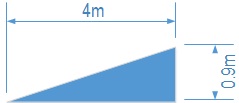
Figure 2: Ramp Dimensions
Determine and use the best suspension stiffness and damping determined from your analysis in the previous Parts.
Use each Simulink model in Parts B, C and D to get an indication of the quad bike's performance over the ramp. You may need to correct/modify the non-linear characteristics. Think of what would be important in the design if the bike was required to perform the stunt and use each of the Simulink models to help improve the suspension parameters and mass distribution. Each Simulink model will help in different ways.
Discuss the free flight behaviour of the truck over the jump and the simulation of ground contact forces.
Draw conclusions if you were to increase the number of DOF's of how accuracy will be improved.
Part F: Discussion and Conclusion
Reflect and discuss the following points in regards to the quad bike analysis:
Compare the results of the different analysis of the quad bike done in Parts B, C and D. In which cases was the simple model (Part B) suitable, and in which cases was higher order models required (Part C and D).
Discus the usefulness of the different analysis performed in determining the suspension stiffness and damping values of the quad bike.
Discuss the differences between your linear and non-linear models of the quad bike.
Based on the quad bike analysis, reflect on the: differences, advantages and disadvantages of frequency domain analysis (Laplace, frequency response etc.) verses time domain (simulation, time series outputetc.).
Reflect on your final suspension design for the quad bike. i.e. Do you think the spring - damper combination selected is suitable? How could it be improved? What method/steps would you do to improve it? Would you have done anything different if you were to redo the design/analysis?
Write a final conclusion to the whole project report, stating the best suspension stiffness and damping you have found from all your analysis. Summarise your key findings and observations.
Attachment:- Project.rar