Section A.
Q1. This is an open-ended question, you will have to make a case, and the marks awarded for effort and making the case. Innovative answers are also of interest.
A few issues to note and look up
Fuel efficiency.
CER.
E-cars.
Winter/summer conditions.
Charging efficiency at home.
Efficiency of the charge controller.
Road tax.
Charging infrastructure.
Value you place on time.
Other cars are available in the battery field, 30kWh Leaf, Zoe, Ioniq
I have an electric car, a Leaf 24kWh version.
I want to be able to compare it to a diesel car, a Mazda3, 1600CC for the following journeys.
700, 1500 and 2500km a month.
The capital cost of the two cars, after grants is the same.
Assume the 700km figure includes one 170km round trip at the weekends, outskirts of Limerick city to Carrig Road high-speed charger in Roscrea. Rest of 700km is daily the same.
The other two are a run around of 100km at the weekend, and the rest over a 20-day period, the same distance each day.
Make a case, for or against the choices.
Look at cost from a chosen supplier of power at home, SSE, BG, ESB, etc.
CO2.
NOx
SOx
Sentiment.
Etc.
Do not look at a hybrid, they are in my opinion inane, nor a petrol car.
Q2.
This question is an attempt to correlate the use of oil and the growth of the world's population. Population, or demographics, is rather an interesting topic. It is all caught up in available energy, religious and social influences, etc. We will not consider the religious and social influences, while important in many cultures, is outside the remit of engineers.
We will only look at oil; the population of the UK mushroomed with the explosion of the use of coal in the 18th and 19th centuries. I want to see if the same effects happened in the last century, and early years of this.
You need to look at some sources on the web for data to do this question:
(1) The Statistical Review of World Energy
(2) Data for population back to 1900. The UN is a good source for this.
(3) Data for oil production prior to 1950.
Note that the way stat's are presented; some show barrels, some show Mtoe, etc.
This is obviously a first order attempt at the problem.
Figures vary from source to source as to our reliance on fossil fuels in giving us protein.
Some sources quote 40% of our protein comes from fossil fuels.
(a) Using data from the BP, UN and other web sites, make up a spread sheet of population, 1900 to 2010, 111 years (A Nelson in cricket parlance!)
Using EXCEL, and any other method, e.g. MINITAB, etc., determine a trend line/equation for thisdata that relates the population to oil consumption. Oil consumption is the independent variable, population the dependent one.
The methodology for this is covered in Stat's.
Issue: do not regurgitate stats from sources and the projections of others, do the correlations! The web is full of that, I want you to do the maths.
(b) Here we will make an assumption that oil production from 2010 will drop 5% per annum, off the 2010, figure. An arbitrary choice on my part. It is 5% simple, not compounded. The figure in 2011 will be 2010 * 0.95, that in 2012, 2010 * 0.9, etc.
Using the equation developed in part (a) above, predict the population out to when oil runs out, based on my arbitrary choice of a 5% drop.
Show the results in a spread sheet; again oil is the independent variable, population the dependent one.
(c) This is obviously a simplistic approach. Comment, qualitatively, on how you could fine tune the model. Ignore cultural and religious norms.
Section B
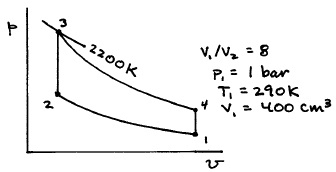
Q3. The Otto cycle is widely used in petrol car engines. At the beginning of the compression process of an air-standard Otto cycle, p1 = 1 bar, 100 kPa, T1 = 290 K, V1 = 400 cm3. The maximum temperature in the cycle is 2200 K and the compression ratio is 8.0. Determine:
(a) The heat addition, in kJ
(b) The net work, in kJ.
(c) The thermal efficiency is ≅ 51%
(d) The mean effective pressure in bar.
(e) On part (c) comment on your answer in the light of this statement:
Q4. (a) For the air standard Brayton Cycle engine covered in Lecture 6, P32 - 36, derive the efficiency figure given on P36.
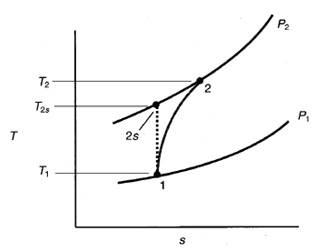
(b) An actual gas turbine cycle must take account of irreversibilities. The T - s diagram for this is shown below. Derive an expression for the work of compression, Wc.
(c) A gas turbine plant has the following data:
Shaft output: 5000kW.
Inlet air temperature: 30ºC.
Air inlet pressure: 97kPa.
Compressor pressure ratio: 5.5
Compressor isentropic efficiency: 0.84
Combustion chamber outlet temperature: 1000ºC.
Combustion chamber pressure loss: 3%.
Turbine isentropic efficiency: 0.88.
Turbine exhaust pressure: 100kPa
Determiner the air flow rate and the thermal efficiency.
(d) Air enters the compressor of an ideal air - standard Brayton cycle at 100kPa, 300K and with a volumetric flow rate of 5m3/s. The compressor pressure ratio is 10. For a turbine inlet temperature in the range of 1000 - 1600K, plot,
(1) The thermal efficiency of the system
(2) The back work ratio
(3) The net power delivered in kW.
Serving suggestions: do one temperature, then repeat on a spread sheet, maybe.
Q5.
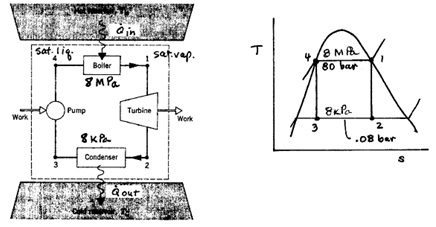
Water is the working fluid in a Carnot vapour power cycle.Saturated liquid enters the boiler at a pressure of 8MPa, andsaturated vapour enters the turbine. The condenser pressure is
8kPa.
(a) Determine the states h1 - h4 and s1 - s4.
(b) The thermal efficiency.
(c) The back work ratio.
(d) The heat transfer to the working fluid per unit mass passing through the boiler, in kJ/kg.
(e) The heat transfer from the working fluid per unit mass passingthrough the condenser, in kJ/kg.
(f) Compare the results of parts (a)-(d), with the correspondingvalues of the example covered in notes and comment.
You must clearly show all steps.
Q6.
A base load coal fired power plant is rated at 1000MWe. It has a thermal efficiency of 35%. It burns coal with the following analysis:
Energy content: 30MJ/kg.
Nitrogen content: 1%
Mineral ash: 10%
Sulphur content: 2%
Calculate the following:
(a) How much electricity does the power plant generate in kWh per annum.
(b) How much coal does the plant consume per annum in tonnes.
(c) How much SO2 and NO2 does the plant emit per annum.
(d) How much fly ash does the power plant emit.
(e) Compare these results to permitted US, Japanese and EU limits.
Q7 (a)
The candy man told me that a well-known snack bar, formally known as "a not so well- known" candy bar plus one vitamin pill a day is a complete food. This was great news to me, as I live off the stuff, so I rushed off to my local supermarket and bought a truck load of the
well-known candy bar, at a fantastic discount. I reckon these bars will last me well into my 90's!
To determine this, I must know how many to eat per day. You see, I am an 8MJ a day guy. Calculate this for me. The well-known bar has the following data printed on the back, barely visible:
(b) I went "ape" over the summer and put on a few kg, but now I am back with a new cohort of 4th years and "rearing" to go. Well beer bellies are not born you know, they are made.
Typically I am a "gas guzzler" and intake 8000kJ a day. But I plan to cut my intake in half. Boy oh boy will those kilo's fall off, and I will lose 5kg in "no time" In other words estimate how long "no time" will be for me.