Question: Looking the other way
Divide into two groups and prepare arguments for and against the following behavior: You have been sent to investigate a fraud claim made against your company by the Customs [department] in one of the countries where you do business. On arrival, an officer explains that your company is being fined for underdeclaring the number of safety boots imported into the country. You notice he is wearing a pair of the "missing" boots. In preparation for your trip you verified that all the shipment and customs paperwork was in order, and you are certain that the number of safety boots has not been under declared.
Since your company's strategic plan features high growth expectations from this region, you are tempted to simply pay the fi ne and get the officer's name and address so you can send him some other samples of your company's products. However, your company's senior management team recently returned from a strategic planning retreat in which they made a clear commitment to enforce the organization's code of ethics in all business transactions, here and abroad, even at the risk of losing short-term business. Your CEO was quoted in the company newsletter as saying: "We should use our higher moral standards as an opportunity to win customers who want to do business with a reputable organization." So you reach into your briefcase for your copies of the customs paperwork and begin to challenge the officer's accusation of under declaring.
Thinking Critically
TOMS SHOES: ETHICALLY GLOBAL?
The focus of most of the chapters in this text has been on companies seeking (or in many cases failing) to operate according to clearly established ethical principles that guide how they treat their stakeholders. The concept of "doing the right thing" has been presented as a natural alignment to their central business purpose, whether that's making cars, computers, or providing fi nancial or consulting services. But what about a company that was started specifi cally to do the right thing? Not a consulting company to advise other companies on ethical business practices, but a company whose core purpose is "conscious capitalism"-delivering a product as a means to another end. In 2006 Blake Mycoskie was inspired by a visit to Argentina to bring the traditional Argentine alpargata slip-on shoe to the U.S. market. Not an unusual decision for a serial entrepreneur like Mycoskie, but what made this idea unique was his purpose for this business.
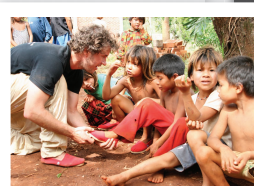
While doing community service work in Argentina, Mycoskie was struck by the country's health and poverty problems-and in particular the large numbers of children without shoes. His idea was to work with Argentinean shoemakers and vendors to produce shoes with vibrant colors and prints for the U.S. market and to offer those genuine alpargata shoes at a price point that would allow his company to give away one pair free for every pair sold. Mycoskie originally intended to give 200 pairs of shoes to the children of Los Piletones in Argentina, but the buy-one-give-one-away model proved so successful that the first "shoe drop," as the donation visits have become known, delivered 10,000 pairs of shoes to match 10,000 pairs purchased by customers at such retailers as Bloomingdale's, Nordstrom's, and Urban Outfitters. In the four years since Mycoskie's company TOMS was founded, over 600,000 pairs of shoes have been donated in Argentina, Haiti, and Ethiopia. The Ethiopian shoe drops are especially significant because of a local disease called podoconiosis, a form of elephantiasis. Contracted through the soil, the disease causes disfigurement and ulcers in the lower legs, and sufferers are ultimately banished from their villages like lepers.
The good news is that the disease is 100 percent preventable by wearing shoes, and the last Ethiopian shoe drop delivered 37,000 pairs. An important point to remember when learning about TOMS is that this is a for-profit company. Mycoskie was inspired by the Newman's Own company started by actor Paul Newman and writer A. E. Hotchner in 1982, which has donated over $300 million to community and health-related benefit programs in the last three decades. Newman's Own is also for profit. The pursuit of a favorable tax status as a nonprofit company was never the point; it was the ability to give away the profits to worthy causes-that's why the companies were created in the first place.