Ask Microeconomics Expert

Question 1  (Demand Elasticity )

Commuters in a medium-sized city can travel either by automobile or by bus. The demand for automobile travel has been estimated to be

981_Q_1.png All exponents are constant elasticities (direct or cross).

where:

Q     =   automobile trips per hour (peak-hour)

a     =   constant

A     =   travel time by automobile (in minutes)

B     =   travel time by bus (in minutes)

C     =   average cost by automobile (in cents)

D     =   average cost by bus (fare, in cents)


(a)      The exponent of D in the above equation is +0.75.  What does this say about the effect of bus fare on the demand for auto travel?

(b)      Is the demand for auto with respect to auto travel-time elastic or inelastic?  Please explain.

(c)       Because of the congestion that is likely to occur on this corridor, the travel time by automobile would increase by 20%, and travel time by bus would increase by 10%.  At the same time, auto travel costs are expected to increase by 5% and bus costs (fare) would be decreased by 15%.  Based on the equation above, what will the percent change in auto travel be?

Question 2 (Congestion Pricing )

Please explain (if possible with diagrams) how is the introduction of a high-occupancy lane (HOV) on a highway equivalent to congestion pricing (e.g., charging monetary toll) in order to bring efficiency (system optimality) in peak traffic flows.


Question 3  (UTP - Trip Distribution)

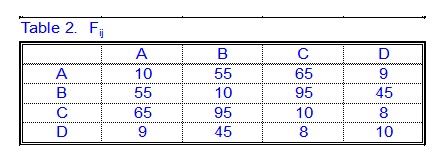
A four-zone study area has the trip productions (origins) and zonal attractiveness shown in the Table 1.   The inter-zonal and intra-zonal friction factors are as given in Table 2.
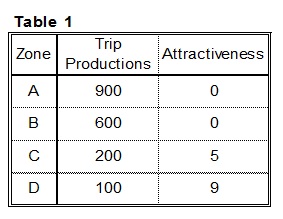
1823_table_1.jpg

1752_table_2.jpg

Determine all zonal interchange volumes (Tij), using the gravity model.


Question 4. (Mode Choice)

A city commuter population has the following modal utility function, Uk = Ak - 0.003C - 0.04T


Where        Ak   constant for mode k

                 C    out-of-pocket travel cost in cents.

                 T    riding time in minutes

(a)    Apply the logit model to calculate the market shares of the two travel modes used in the city.


                           Mode                        Ak                     C                      T

                           Automobile               -0.20                240                  25

                           Regular city bus        -0.60                  80                  55


(b)   Suppose, in addition to the regular city bus, a private company starts its bus service along the same routes as the city bus with the following characteristics:

                           Mode                        Ak                     C                      T

                           Private bus                -0.60                  80                  55


            Determine the new market shares of auto, city bus and private bus.


Question 5 (10 points) (All-or-nothing / incremental assignment)

For the network shown below, 4 units of flow go from node 1 to node 3.  The average travel time functions on these links are:

ta = 3 + Xa2

tb = 1 + 3Xb

tc = 2 + Xc

(a)    Assign the 4 units of flow from node 1 to node 3 using incremental ( i.e., one unit at a time) capacitated ALL-OR-NOTHING assignment technique.  Show your work step by step as well as the final link flows  (Xa , Xb , Xc ).

(b)   Are the resulting flows in system optimum or user equilibrium?  Please explain.

Question 6 (User-Equilibrium vs. System Optimum Traffic Assignment)


For the network shown below, the following origin-destination volumes are the only volumes to be assigned to the network:VAC = 800               VBC = 100      VBD = 900

The link travel time (average travel time) functions are as follows (all times are in minutes): 


t1  =  10 + 0.01 x1

t2  =    3 + 0.02 x2

t3  =    2 + 0.02 x3

t4  =    3 + 0.02 x4

t5  =    4 + 0.02 x5

t6  =  12 + 0.01 x6


t7  =    4 + 0.02 x7

(For both parts (a) and (b ), round up your time calculations to the nearest tenth of a minute.)


(a)   A CEE 3610 student calculated the user-equilibrium link flows as follows:


x1  =                            780

x2  =   20

x3  = 202

x4  = 120

x5  =                                     182

x6  =                                     818

x7  =                                      82 

Is he correct?  Why?

(b)   Another CEE 3610 student calculated the system-optimum link flows as follows:


x1  =    749

x2  =    51

x3  =    222

x4  =    151

x5  =    171

x6  =    829

x7  =    71


Is she correct?  Why? 

Microeconomics, Economics

  • Category:- Microeconomics
  • Reference No.:- M9743939
  • Price:- $45

Priced at Now at $45, Verified Solution

Have any Question?


Related Questions in Microeconomics

Question show the market for cigarettes in equilibrium

Question: Show the market for cigarettes in equilibrium, assuming that there are no laws banning smoking in public. Label the equilibrium private market price and quantity as Pm and Qm. Add whatever is needed to the mode ...

Question recycling is a relatively inexpensive solution to

Question: Recycling is a relatively inexpensive solution to much of the environmental contamination from plastics, glass, and other waste materials. Is it a sound policy to make it mandatory for everybody to recycle? The ...

Question consider two ways of protecting elephants from

Question: Consider two ways of protecting elephants from poachers in African countries. In one approach, the government sets up enormous national parks that have sufficient habitat for elephants to thrive and forbids all ...

Question suppose you want to put a dollar value on the

Question: Suppose you want to put a dollar value on the external costs of carbon emissions from a power plant. What information or data would you obtain to measure the external [not social] cost? The response must be typ ...

Question in the tradeoff between economic output and

Question: In the tradeoff between economic output and environmental protection, what do the combinations on the protection possibility curve represent? The response must be typed, single spaced, must be in times new roma ...

Question consider the case of global environmental problems

Question: Consider the case of global environmental problems that spill across international borders as a prisoner's dilemma of the sort studied in Monopolistic Competition and Oligopoly. Say that there are two countries ...

Question consider two approaches to reducing emissions of

Question: Consider two approaches to reducing emissions of CO2 into the environment from manufacturing industries in the United States. In the first approach, the U.S. government makes it a policy to use only predetermin ...

Question the state of colorado requires oil and gas

Question: The state of Colorado requires oil and gas companies who use fracking techniques to return the land to its original condition after the oil and gas extractions. Table 12.9 shows the total cost and total benefit ...

Question suppose a city releases 16 million gallons of raw

Question: Suppose a city releases 16 million gallons of raw sewage into a nearby lake. Table shows the total costs of cleaning up the sewage to different levels, together with the total benefits of doing so. (Benefits in ...

Question four firms called elm maple oak and cherry produce

Question: Four firms called Elm, Maple, Oak, and Cherry, produce wooden chairs. However, they also produce a great deal of garbage (a mixture of glue, varnish, sandpaper, and wood scraps). The first row of Table 12.6 sho ...

  • 4,153,160 Questions Asked
  • 13,132 Experts
  • 2,558,936 Questions Answered

Ask Experts for help!!

Looking for Assignment Help?

Start excelling in your Courses, Get help with Assignment

Write us your full requirement for evaluation and you will receive response within 20 minutes turnaround time.

Ask Now Help with Problems, Get a Best Answer

Why might a bank avoid the use of interest rate swaps even

Why might a bank avoid the use of interest rate swaps, even when the institution is exposed to significant interest rate

Describe the difference between zero coupon bonds and

Describe the difference between zero coupon bonds and coupon bonds. Under what conditions will a coupon bond sell at a p

Compute the present value of an annuity of 880 per year

Compute the present value of an annuity of $ 880 per year for 16 years, given a discount rate of 6 percent per annum. As

Compute the present value of an 1150 payment made in ten

Compute the present value of an $1,150 payment made in ten years when the discount rate is 12 percent. (Do not round int

Compute the present value of an annuity of 699 per year

Compute the present value of an annuity of $ 699 per year for 19 years, given a discount rate of 6 percent per annum. As