Ask Microeconomics Expert

Assignment - Time Series Models

Instructions: You need to write a Stata do-file to answer question 2. Your do-file must produce a log file that contains your Stata output.

1. We want to forecast the unemployment rate in the United States (UrateUS) using quarterly data from the first quarter of 1980 to the fourth quarter of 2016 (T = 36 years x 4 quarters= 144).

a) The following table presents the first four autocorrelations for the United States unemployment rate and its changes over the time period from Q1:1980 to Q4:2016. Explain briefly what the auto-correlations in the unemployment rate, Yt, measure.

Table 1: First Four Autocorrelations of the U.S. Unemployment Rate and Its Change, 1980:Q1 - 2016:Q4

Lag

Unemployment Rate Yt

Change in Unemployment Rate ΔYt

1

0.97

0.62

2

0.92

0.32

3

0.83

0.12

4

0.75

-0.07

b) The accompanying table gives the United States unemployment rate for the period 2015:Q1-2016:Q1 in levels, and the lagged unemployment rate for 2015:Q1. Fill in the blanks for the missing lagged values and the changes in the unemployment rate.

Table 2: Changes in Unemployment Rates in the U.S., Q1:2015 to Q1:2016

Quarter

Unemployment Rate Yt

First Lag

Change in Unemployment Rate ΔYt

Q1:2015

4.3

4.4


Q2:2015

4.3


Q3:2015

4.2


Q4:2015

4.1


Q1:2016

4.0


(c) You decide to test whether the unemployment rate is nonstationary. The result is as follows:
1254_figure.png

Is the unemployment rate series nonstationary? Why or why not?

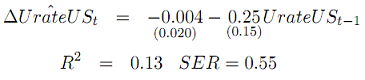
(d) You decide to estimate an AR(1) model using changes (i.e., first-differences) in the US unemployment rate. The result is as follows:

2421_figure1.png

If most of the forecast error comes from uncertainty about the future error terms instead of sampling error from estimating the coefficients in the AR(1) model, then what is your best guess of the RMSFE here?

(e) The actual unemployment rate during the fourth quarter of 2015 is 4.1 percent, and it decreased from the third quarter to the fourth quarter by 0.1 percent. Using the AR(1) model's results, what is your forecast for the unemployment rate level in the first quarter of 2016?

(f) You want to see how sensitive your forecast is to changes in the specification, so you consider an AR(4) model. The results are as follows:

489_figure2.png

What is your forecast for the unemployment rate level in 2016:Q1? Compare the forecast error of the AR(4) model with the forecast error of the AR(1) model.

(g) Given the information below, which model should you use for forecasting?

p

BIC

AIC

R2

0

0.604

0.624

0.000

1

0.158

0.118

0.393

2

0.185

0.125

0.397

3

0.217

0.138

0.400

4

0.218

0.119

0.416

5

0.277

0.139

0.420

2. The data set macro.dta contains time series data for U.S. real aggregate personal consumption (cons), real gross domestic investment (invest), interest rates on 3 month Treasury Bills (intrate), real M1 money stock (m1), and real GDP (gdp) for 1947:Q1 -1988:Q1. cons, invest, m1 and gdp are all measured in billions of 1982 dollars.

a) Estimate autocorrelations for log(cons), log(gdp), log(m1) and intrate and their first differences. What can you say about the stationarity or non-stationarity of each series?

b) Conduct the Dickey-Fuller test for unit roots in each of the variables listed in part (a). Use 8 lags in each of the Dickey-Fuller regressions. What do you conclude for each series?

c) The Keynesian consumption function is log(cons) = β0 + β1 log(gdp) + u. Estimate this regression as specified and in first-differenced form. Interpret the effect of gdp on cons. Does your interpretation change substantively in the two versions? Which estimates are more reliable?

d) The Keynesian money demand function is log(m1) = β0 + β1 log(gdp) + β2intrate + u. Estimate this regression as specified and in first-differenced form. Interpret the effects of gdp and intrate on m1. Does your interpretation change substantively in the two versions? Which estimates are more reliable?

Attachment:- Assignment Files.rar

Microeconomics, Economics

  • Category:- Microeconomics
  • Reference No.:- M92816851

Have any Question?


Related Questions in Microeconomics

Question show the market for cigarettes in equilibrium

Question: Show the market for cigarettes in equilibrium, assuming that there are no laws banning smoking in public. Label the equilibrium private market price and quantity as Pm and Qm. Add whatever is needed to the mode ...

Question recycling is a relatively inexpensive solution to

Question: Recycling is a relatively inexpensive solution to much of the environmental contamination from plastics, glass, and other waste materials. Is it a sound policy to make it mandatory for everybody to recycle? The ...

Question consider two ways of protecting elephants from

Question: Consider two ways of protecting elephants from poachers in African countries. In one approach, the government sets up enormous national parks that have sufficient habitat for elephants to thrive and forbids all ...

Question suppose you want to put a dollar value on the

Question: Suppose you want to put a dollar value on the external costs of carbon emissions from a power plant. What information or data would you obtain to measure the external [not social] cost? The response must be typ ...

Question in the tradeoff between economic output and

Question: In the tradeoff between economic output and environmental protection, what do the combinations on the protection possibility curve represent? The response must be typed, single spaced, must be in times new roma ...

Question consider the case of global environmental problems

Question: Consider the case of global environmental problems that spill across international borders as a prisoner's dilemma of the sort studied in Monopolistic Competition and Oligopoly. Say that there are two countries ...

Question consider two approaches to reducing emissions of

Question: Consider two approaches to reducing emissions of CO2 into the environment from manufacturing industries in the United States. In the first approach, the U.S. government makes it a policy to use only predetermin ...

Question the state of colorado requires oil and gas

Question: The state of Colorado requires oil and gas companies who use fracking techniques to return the land to its original condition after the oil and gas extractions. Table 12.9 shows the total cost and total benefit ...

Question suppose a city releases 16 million gallons of raw

Question: Suppose a city releases 16 million gallons of raw sewage into a nearby lake. Table shows the total costs of cleaning up the sewage to different levels, together with the total benefits of doing so. (Benefits in ...

Question four firms called elm maple oak and cherry produce

Question: Four firms called Elm, Maple, Oak, and Cherry, produce wooden chairs. However, they also produce a great deal of garbage (a mixture of glue, varnish, sandpaper, and wood scraps). The first row of Table 12.6 sho ...

  • 4,153,160 Questions Asked
  • 13,132 Experts
  • 2,558,936 Questions Answered

Ask Experts for help!!

Looking for Assignment Help?

Start excelling in your Courses, Get help with Assignment

Write us your full requirement for evaluation and you will receive response within 20 minutes turnaround time.

Ask Now Help with Problems, Get a Best Answer

Why might a bank avoid the use of interest rate swaps even

Why might a bank avoid the use of interest rate swaps, even when the institution is exposed to significant interest rate

Describe the difference between zero coupon bonds and

Describe the difference between zero coupon bonds and coupon bonds. Under what conditions will a coupon bond sell at a p

Compute the present value of an annuity of 880 per year

Compute the present value of an annuity of $ 880 per year for 16 years, given a discount rate of 6 percent per annum. As

Compute the present value of an 1150 payment made in ten

Compute the present value of an $1,150 payment made in ten years when the discount rate is 12 percent. (Do not round int

Compute the present value of an annuity of 699 per year

Compute the present value of an annuity of $ 699 per year for 19 years, given a discount rate of 6 percent per annum. As