Questions 1 and 2 refer to the following diagram.
The following graph represents Larry's budget constraint and preferences:
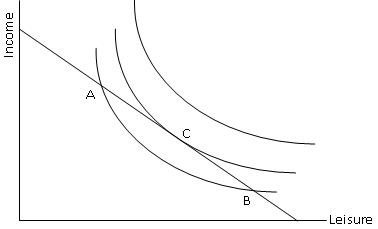
1. At point A, Larry's marginal rate of substitution of leisure for income:
Select one:
a. exceeds the wage and Larry would like to work more hours
b. exceeds the wage and Larry would like to work fewer hours
c. is less than the wage and Larry would like to work more hours
d. is less than the wage and Larry would like to work fewer hours
2. Consider the three combinations of leisure and income represented by points A, B, and C. Which of the following is a correct statement?
Select one:
a. Larry prefers A to B
b. Larry prefers A to C
c. Larry prefers B to C
d. Larry prefers C to A
Questions 3 - 6 refer to the following diagram:
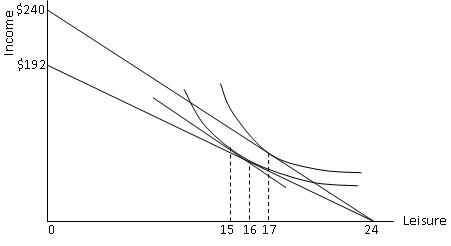
3. Considering the two budget lines in the diagram, if the person's optimal number of hours worked is seven hours, then the wage rate must be:
Select one:
a. $10
b. $192
c. $240
d. cannot be determined
4. This person has non-wage income of:
Select one:
a. $0
b. $10
c. $192
d. $240
5. If this person's wage rate falls as illustrated in the diagram, then:
Select one:
a. the substitution effect is stronger than the income effect
b. the income effect is stronger than the substitution effect
c. this person's non-wage income will fall as well
d. the substitution effect causes desired work hours to increase
6. The income effect of the illustrated wage decrease causes this individual to work:
Select one:
a. one less hour
b. one more hour
c. two less hours
d. two more hours
7. Question 7 is based on the following diagram.
TS represents the standard 40-hour workweek. Indifference curves labeled with subscripts "a" and "b" are for individuals A and B, respectively.
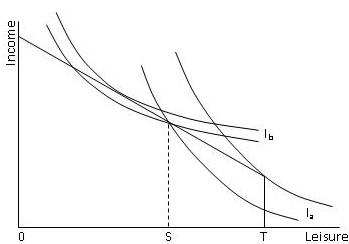
Assuming workers must work TS hours or not at all, worker A will:
Select one:
a. not participate in the labor force
b. be at an optimum at TS hours of work
c. work the standard workweek but will feel overemployed
d. work the standard workweek but will feel underemployed
Question 8 refers to the following diagram:
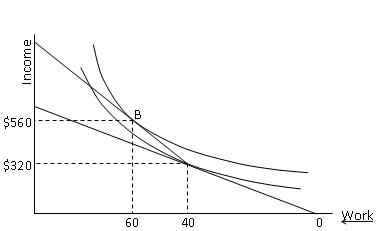
8. Suppose this worker is currently working 40 hours per week and earning $8 per hour. Which one of the following would cause a move to point B, and the subsequent increase in work hours to 60?
Select one:
a. The availability of overtime work at $12 per hour
b. The availability of a moonlighting job that pays $6 per hour
c. An increase in the straight-time wage to $9.33 per hour
d. An increase in non-wage income of $240
Question 9 refers to the following diagram :
In the accompanying diagram WH is the budget line resulting from labor market work. There are three income maintenance programs implicit in the budget lines: HBW ', HBYW and HBW
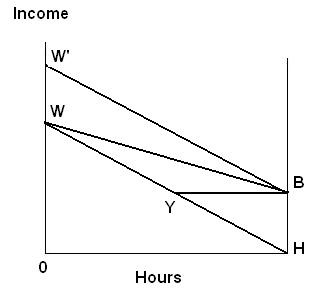
9. Given an individual's (normal) work-leisure preferences, which income maintenance program will elicit the strongest disincentives to work?
Select one:
a. HBW '
b. HBYW
c. HBW
d. Unable to determine
10. Which of the following best exemplifies the Becker income effect? An increase in the market wage leads a household to:
Select one:
a. substitute time for goods in the production of commodities
b. consume fewer time-intensive commodities and more goods intensive commodities
c. consume more commodities
d. have fewer children
11. In a particular family, both spouse A and spouse B could earn $20 per hour in market work. However, spouse A has a comparative advantage in the production of home-produced goods. Becker's model of time allocation predicts that:
Select one:
a. spouse B will be better able to substitute time for goods in the production of commodities
b. spouse A and spouse B will divide market work and home production equally
c. spouse A will tend to specialize in market work; spouse B in home production
d. spouse A will tend to specialize in home production; spouse B in market work
12. Which one of the following gives rise to a retirement-inducing substitution effect? As workers approach retirement age:
Select one:
a. Social Security benefits become available
b. wealth becomes sufficient to make retirement affordable
c. earnings potential decreases and leisure becomes relatively more costly
d. earnings potential decreases and leisure becomes relatively less costly
13. Empirical evidence suggests that the:
Select one:
a. added-worker effect dominates the discouraged-worker effect; the participation rate varies inversely with the unemployment rate
b. discouraged-worker effect dominates the added-worker effect; the participation rate varies inversely with the unemployment rate
c. added-worker effect dominates the discouraged-worker effect; the participation rate varies directly with the unemployment rate
d. discouraged-worker effect dominates the added-worker effect; the participation rate varies directly with the unemployment rate
Question 14 refers to the following diagram.
Assume that African-American workers and White-American workers have identical work-leisure preferences (indifference curves) but that African-American workers have (a) labor market opportunities that are inferior to whites and (b) non-labor income available in the form of say, disability benefits.
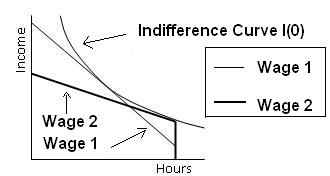
14. Based on the graph, which on of the following statements best depicts the labor force particaption rates of a African-American and White-American worker?
Select one:
a. Both individuals choose to participate in the labor force
b. The African-American worker chooses to enter the labor force, while the White-American does not
c. The African-American worker chooses not to enter the labor force, while the White-American does
d. Both chose not to particpate in the labor force
15. All else equal, rising real wages will:
Select one:
a. decrease average weekly work hours if the income effect exceeds the substitution effect
b. increase average weekly work hours if the income effect exceeds the substitution effect
c. decrease average weekly work hours if the substitution effect exceeds the income effect
d. have no impact on average weekly work hours
16. The stability of the post-World War II era workweek has been attributed to such considerations as (a) higher taxes on earnings, (b) the acquisition of more education, and(c) advertising.
What impact would you expect increased education and advertising to have on the shape of the work-leisure (indifference) curve?
Select one:
a. increase education would change preferences making the indifference curve flatter while advertising would makes it steeper
b. increased education would change preferences making the indifference curve steeper but advertising makes it flatter
c. both increased education and advertising change preferences so that the indifference curve is steeper
d. both increased education and advertising change preferences so that the indifference curve is flatter
Questions 17-19 are based on the following diagram:
In deciding whether or not to go to college, one would compare the discounted value of:
Select one:
a. area 3 to the discounted value of area 1
b. area 3 to the discounted value of area 2
c. area 3 to the discounted value of areas 1 and 2
d. areas 2 and 3 to the discounted value of area 1
18. Which one of the following would increase the likelihood of investing in a college education?
Select one:
a. an increase in area 1
b. a reduction in area 2
c. a reduction in the retirement age
d. a reduction in area 3 and an equal increase in area 2
19. Suppose there is now a 25% likelihood that a person's work career may be interrupted for ten years after schooling has been completed. In the diagram above, this development would:
Select one:
a. have no impact
b. shrink area 1
c. shrink area 2
d. shrink area 3
20. Consider an individual who will invest a total of $10,000 in direct and indirect costs for training in order to increase earnings by $12,500 for the next year. Suppose the interest rate is 8%. If this person plans to retire the following year, the net present value of this investment is:
Select one:
a. zero
b. between $1500 and $2500
c. $2500
d. between $11,500 and $12,500
21. The increase in the college wage premium during the 1980s was most likely caused by:
Select one:
a. increased demand for college graduates due to changes in the structure of the economy
b. increased supply of college graduates from the large "baby boom" generation
c. changes in technology that reduced the relative supply of college-trained workers
d. increased demand for high school graduates, particularly males
22. Studies of the rate of return on human capital must be interpreted with care because:
Select one:
a. the social return may not equal the private return
b. past differences in earnings are no guarantee of future differences in earnings
c. a high average rate of return is no guarantee of a high personal rate of return
d. all of the above
23. Personal differences in demand for human capital curves can be explained by differences in all of the following, except:
Select one:
a. ability
b. access to investment funds
c. discrimination
d. discount rates
24. Which one of the following observations would tend to widen the dispersion of earnings?
Select one:
a. Banks charge higher interest rate on educational loans to those individuals most likely to face discrimination on the job
b. Those with higher ability face higher costs of investment funds
c. Human capital investment demand and supply curves are negatively correlated
d. Poor families pay a larger proportion of family income on education than rich families
25. A worker who has obtained specific training is:
Select one:
a. more likely to establish a long-term association with an employer because the worker has made an investment he does not wish to lose
b. more likely to establish a long-term association with an employer because the employer has made an investment she does not wish to lose
c. both A. and B. are correct: the worker is
1. more likely to establish a long-term association with an employer because the worker has made an investment he does not wish to lose, and
2. more likely to establish a long-term association with an employer because the employer has made an investment she does not wish to lose
d. neither A. nor B. is correct- the worker is
1. more likely to establish a long-term association with an employer because the worker has made an investment he does not wish to lose, and
2. more likely to establish a long-term association with an employer because the employer has made an investment she does not wish to lose