Ask Accounting Basics Expert

Question: Susan Lussier's Inherited Portfolio: Does It Meet Her Needs?

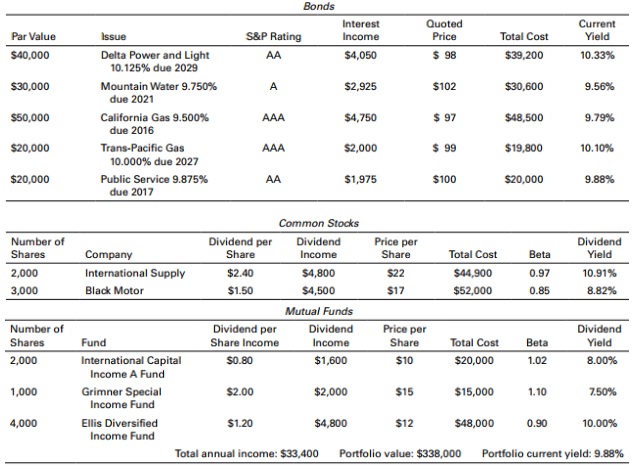
Susan Lussier is 35 years old and employed as a tax accountant for a major oil and gas exploration company. She earns nearly $135,000 a year from her salary and from participation in the company's drilling activities. An expert on oil and gas taxation, she is not worried about job security-she is content with her income and finds it adequate to allow her to buy and do whatever she wishes. Her current philosophy is to live each day to its fullest, not concerning herself with retirement, which is too far in the future to require her current attention. A month ago, Susan's only surviving parent, her father, was killed in a sailing accident. He had retired in La Jolla, California, two years earlier and had spent most of his time sailing. Prior to retirement, he managed a children's clothing manufacturing firm in South Carolina. Upon retirement he sold his stock in the firm and invested the proceeds in a security portfolio that provided him with supplemental retirement income of over $30,000 per year. In his will, he left his entire estate to Susan. The estate was structured in such a way that in addition to a few family heirlooms, Susan received a security portfolio having a market value of nearly $350,000 and about $10,000 in cash. Susan's father's portfolio contained 10 securities: 5 bonds, 2 common stocks, and 3 mutual funds. The following table lists the securities and their key characteristics. The common stocks were issued by large, mature, well-known firms that had exhibited continuing patterns of dividend payment over the past five years. The stocks offered only moderate growth potential- probably no more than 2% to 3% appreciation per year. The mutual funds in the portfolio were income funds invested in diversified portfolios of income-oriented stocks and bonds. They provided stable streams of dividend income but offered little opportunity for capital appreciation.

The Securities Portfolio That Susan Lussier Inherited
1727_1.jpg

Now that Susan owns the portfolio, she wishes to determine whether it is suitable for her situation. She realizes that the high level of income provided by the portfolio will be taxed at a rate (federal plus state) of about 40%. Because she does not currently need it, Susan plans to invest the after-tax income primarily in common stocks offering high capital gain potential. During the coming years she clearly needs to avoid generating taxable income. (Susan is already paying out a sizable portion of her income in taxes.) She feels fortunate to have received the portfolio and wants to make certain it provides her with the maximum benefits, given her financial situation. The $10,000 cash left to her will be especially useful in paying brokers' commissions associated with making portfolio adjustments.

a. Briefly assess Susan's financial situation and develop a portfolio objective for her that is consistent with her needs.

b. Evaluate the portfolio left to Susan by her father. Assess its apparent objective and evaluate how well it may be doing in fulfilling this objective. Use the total cost values to describe the asset allocation scheme reflected in the portfolio. Comment on the risk, return, and tax implications of this portfolio.

c. If Susan decided to invest in a security portfolio consistent with her needs-indicated in response to question a-describe the nature and mix, if any, of securities you would recommend she purchase. Discuss the risk, return, and tax implications of such a portfolio.

d. From the response to question b, compare the nature of the security portfolio inherited by Susan with what you believe would be an appropriate security portfolio for her, based on the response to question c.

e. What recommendations would you give Susan about the inherited portfolio? Explain the steps she should take to adjust the portfolio to her needs.

Accounting Basics, Accounting

  • Category:- Accounting Basics
  • Reference No.:- M92433110
  • Price:- $15

Priced at Now at $15, Verified Solution

Have any Question?


Related Questions in Accounting Basics

Question what discoveries have you made in your research

Question: What discoveries have you made in your research and how does this information inform your ability to evaluate effective coaching and its impact on organizations? Consider these guiding questions: 1. What core c ...

Question requirement 1 read the article in below attachment

Question: Requirement: 1. Read the article in below attachment, and answer the questions in a paper format. Read below requirements before your writing! 2. Not to list the answers, and you should write as a paper format. ...

Question as a financial consultant you have contracted with

Question: As a financial consultant, you have contracted with Wheel Industries to evaluate their procedures involving the evaluation of long term investment opportunities. You have agreed to provide a detailed report ill ...

Question the following information is taken from the

Question: The following information is taken from the accrual accounting records of Kroger Sales Company: 1. During January, Kroger paid $9,150 for supplies to be used in sales to customers during the next 2 months (Febr ...

Assignment 1 lasa 2-capital budgeting techniquesas a

Assignment 1: LASA # 2-Capital Budgeting Techniques As a financial consultant, you have contracted with Wheel Industries to evaluate their procedures involving the evaluation of long term investment opportunities. You ha ...

Assignment 2 discussion questionthe finance department of a

Assignment 2: Discussion Question The finance department of a large corporation has evaluated a possible capital project using the NPV method, the Payback Method, and the IRR method. The analysts are puzzled, since the N ...

Question in this case you have been provided financial

Question: In this case, you have been provided financial information about the company in order to create a cash budget. Management is seeking advice or clarification on three main assumptions the company has been operat ...

Question 1what step in the accounting cycle do adjusting

Question: 1. What step in the accounting cycle do Adjusting Entries show up 2. How do these relate to the Accounting Worksheet? 3. Why are they completed at the end of each accounting period? The response must be typed, ...

Question is it important for non-accountants to understand

Question: Is it important for non-accountants to understand how to read financial statements? If you are not part of the accounting/finance function in a business what difference would it make? The response must be typed ...

Question refer to the hat rack cash flow statement 2002 in

Question: Refer to the Hat Rack Cash Flow Statement, 2002 in the text on page 17. Answer the following questions and submit to me via Canvas by the due date. 1. Cash flow from operations? 2. Cash flow from investing? 3. ...

  • 4,153,160 Questions Asked
  • 13,132 Experts
  • 2,558,936 Questions Answered

Ask Experts for help!!

Looking for Assignment Help?

Start excelling in your Courses, Get help with Assignment

Write us your full requirement for evaluation and you will receive response within 20 minutes turnaround time.

Ask Now Help with Problems, Get a Best Answer

Why might a bank avoid the use of interest rate swaps even

Why might a bank avoid the use of interest rate swaps, even when the institution is exposed to significant interest rate

Describe the difference between zero coupon bonds and

Describe the difference between zero coupon bonds and coupon bonds. Under what conditions will a coupon bond sell at a p

Compute the present value of an annuity of 880 per year

Compute the present value of an annuity of $ 880 per year for 16 years, given a discount rate of 6 percent per annum. As

Compute the present value of an 1150 payment made in ten

Compute the present value of an $1,150 payment made in ten years when the discount rate is 12 percent. (Do not round int

Compute the present value of an annuity of 699 per year

Compute the present value of an annuity of $ 699 per year for 19 years, given a discount rate of 6 percent per annum. As