Question: Charles Spurge, a mathematician with Ansco Petroleum Company, wishes to develop a rational basis for timing his portfolio transactions. He currently holds a security portfolio with a market value of nearly $100,000, divided equally between a very conservative, low-beta common stock, ConCam United, and a highly speculative, high-beta stock, Fleck Enterprises. On the basis of his reading of the investments' literature, Charles does not believe it is necessary to diversify one's portfolio across 8 to 15 securities. His thinking, based on his independent mathematical analysis, is that one can achieve the same results by holding a two-security portfolio in which one security is very conservative and the other is highly speculative. His thinking on this point will not be altered. He plans to continue to hold such a two-security portfolio until he finds that his theory does not work. During the past several years, he has earned a rate of return in excess of the risk adjusted, market-adjusted rate expected on such a portfolio. Charles's current interest centers on possibly developing his own formula plan for timing portfolio transactions. The current stage of his analysis focuses on the evaluation of four common formula plans in order to isolate the desirable features of each. The plans he is considering are
(1) dollar-cost averaging,
(2) the constant-dollar plan,
(3) the constant-ratio plan, and
(4) the variable-ratio plan.
Charles's analysis of the plans will involve two types of data. Dollar-cost averaging is a passive buy-and-hold strategy in which the periodic investment is held constant. The other plans are more active in that they involve periodic purchases and sales within the portfolio. Thus, differing data are needed to evaluate the plans. For evaluating the dollar-cost averaging plan, Charles decided he would assume an investment of $500 at the end of each 45-day period. He chose 45-day time intervals to achieve certain brokerage fee savings that would be available by making larger transactions. The $500 per 45 days totaled $4,000 for the year and equaled the total amount Charles invested during the past year. The share prices for each of the stocks at the end of the eight 45-day periods when purchases were to be made are given in the accompanying table.
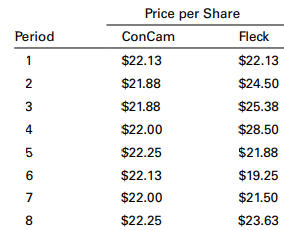
To evaluate the three other plans, Charles decided to begin with a $4,000 portfolio evenly split between the two stocks. He chose to use $4,000 because that amount would correspond to the total amount invested in the two stocks over one year using dollar-cost averaging.
He planned to use the same eight points in time given earlier to assess the portfolio and make transfers within it if required. For each of the plans evaluated using these data, he established the following triggering points. Constant-dollar plan. Each time the speculative portion of the portfolio is worth 13% more or less than its initial value of $2,000, the portfolio is rebalanced to bring the speculative portion back to its initial $2,000 value. Constant-ratio plan. Each time the ratio of the value of the speculative portion of the portfolio to the value of the conservative portion is
(1) greater than or equal to 1.15 or
(2) less than or equal to 0.84,
the portfolio is rebalanced through sale or purchase, respectively, to bring the ratio back to its initial value of 1.0. Variable-ratio plan. Each time the value of the speculative portion of the portfolio rises above 54% of the total value of the portfolio, its proportion is reduced to 46%. Each time the value of the speculative portion of the portfolio drops below 38% of the total value of the portfolio, its proportion is raised to 50%.
a. Under the dollar-cost averaging plan, determine the total number of shares purchased, the average cost per share, and the year-end portfolio value expressed both in dollars and as a percentage of the amount invested for
(1) the conservative stock,
(2) the speculative stock, and
(3) the total portfolio.
b. Using the constant-dollar plan, determine the year-end portfolio value expressed both in dollars and as a percentage of the amount initially invested for
(1) the conservative portion,
(2) the speculative portion, and
(3) the total portfolio.
c. Repeat question b for the constant-ratio plan. Be sure to answer all parts.
d. Repeat question b for the variable-ratio plan. Be sure to answer all parts.
e. Compare and contrast your results from questions a through d. You may want to summarize them in tabular form. Which plan would appear to have been most beneficial in timing Charles's portfolio activities during the past year? Explain.