Ask Microeconomics Expert

Question: 7-Eleven
"Convenience" Is Born

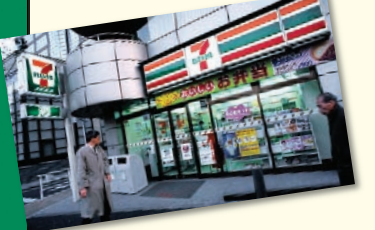
In 1927 an employee of the Southland Ice Company in Dallas, Texas, began selling milk, bread, and eggs from the ice dock on Sundays and evenings when grocery stores were closed. This sparked the idea for the convenience store. In 1946 the stores were renamed 7-Eleven to reflect their new hours: 7 a.m. to 11 p.m.
1423_7.png

Japan Borrows the Idea

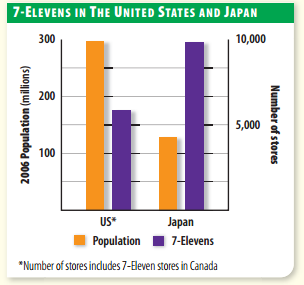
In the early 1970s, Toshifumi Suzuki, a young Japanese executive, came to the United States to look into franchising Denny's restaurants in Japan. He was more impressed by the 7-Elevens he saw. With its densely populated cities and small commercial lots, Japan was perfectly suited to the convenience-store format. In 1974 Suzuki opened a chain of stores under the 7-Eleven name. Since then, the retailer has changed the way the country shops and eats. Many stores offer banking services, dry-cleaning drop-off, parcel post, mobile-phone recharging, photocopying, and even voter registration. They also stock cheap, high-quality foods, such as gourmet rice balls, exotic salads, and other delicacies customized to local tastes. Technology, coordinated deliveries, and inventory control have boosted efficiency. The company uses a satellite-based ordering system that includes detailed weather reports. This way, managers know to order more cold noodles on warm days or more fresh produce on rainy days, when customers want to avoid a trip to the grocery store. Today 7-Eleven is Japan's most profitable retailer.
2295_7.1.png

The Student Buys the Teacher

While 7-Eleven Japan boomed, its U.S. counterpart declined. In the late 1980s, 7-Eleven Japan and its parent company, Ito-Yokado, helped turn around the U.S. stores. They improved the U.S. distribution network and introduced new sandwiches, bakery items, and coffees. In 1991, ItoYokado bought 70 percent of the American company outright. Today nearly 30,000 7-Eleven stores generate total sales of more than $43 billion in 17 countries and U.S. territories.

1. Drawing Conclusions How do you know that 7-Eleven is a multinational corporation?

2. Comparing and Contrasting In what ways do 7-Elevens in Japan differ from their U.S. counterparts?

Microeconomics, Economics

  • Category:- Microeconomics
  • Reference No.:- M92294335

Have any Question?


Related Questions in Microeconomics

Question show the market for cigarettes in equilibrium

Question: Show the market for cigarettes in equilibrium, assuming that there are no laws banning smoking in public. Label the equilibrium private market price and quantity as Pm and Qm. Add whatever is needed to the mode ...

Question recycling is a relatively inexpensive solution to

Question: Recycling is a relatively inexpensive solution to much of the environmental contamination from plastics, glass, and other waste materials. Is it a sound policy to make it mandatory for everybody to recycle? The ...

Question consider two ways of protecting elephants from

Question: Consider two ways of protecting elephants from poachers in African countries. In one approach, the government sets up enormous national parks that have sufficient habitat for elephants to thrive and forbids all ...

Question suppose you want to put a dollar value on the

Question: Suppose you want to put a dollar value on the external costs of carbon emissions from a power plant. What information or data would you obtain to measure the external [not social] cost? The response must be typ ...

Question in the tradeoff between economic output and

Question: In the tradeoff between economic output and environmental protection, what do the combinations on the protection possibility curve represent? The response must be typed, single spaced, must be in times new roma ...

Question consider the case of global environmental problems

Question: Consider the case of global environmental problems that spill across international borders as a prisoner's dilemma of the sort studied in Monopolistic Competition and Oligopoly. Say that there are two countries ...

Question consider two approaches to reducing emissions of

Question: Consider two approaches to reducing emissions of CO2 into the environment from manufacturing industries in the United States. In the first approach, the U.S. government makes it a policy to use only predetermin ...

Question the state of colorado requires oil and gas

Question: The state of Colorado requires oil and gas companies who use fracking techniques to return the land to its original condition after the oil and gas extractions. Table 12.9 shows the total cost and total benefit ...

Question suppose a city releases 16 million gallons of raw

Question: Suppose a city releases 16 million gallons of raw sewage into a nearby lake. Table shows the total costs of cleaning up the sewage to different levels, together with the total benefits of doing so. (Benefits in ...

Question four firms called elm maple oak and cherry produce

Question: Four firms called Elm, Maple, Oak, and Cherry, produce wooden chairs. However, they also produce a great deal of garbage (a mixture of glue, varnish, sandpaper, and wood scraps). The first row of Table 12.6 sho ...

  • 4,153,160 Questions Asked
  • 13,132 Experts
  • 2,558,936 Questions Answered

Ask Experts for help!!

Looking for Assignment Help?

Start excelling in your Courses, Get help with Assignment

Write us your full requirement for evaluation and you will receive response within 20 minutes turnaround time.

Ask Now Help with Problems, Get a Best Answer

Why might a bank avoid the use of interest rate swaps even

Why might a bank avoid the use of interest rate swaps, even when the institution is exposed to significant interest rate

Describe the difference between zero coupon bonds and

Describe the difference between zero coupon bonds and coupon bonds. Under what conditions will a coupon bond sell at a p

Compute the present value of an annuity of 880 per year

Compute the present value of an annuity of $ 880 per year for 16 years, given a discount rate of 6 percent per annum. As

Compute the present value of an 1150 payment made in ten

Compute the present value of an $1,150 payment made in ten years when the discount rate is 12 percent. (Do not round int

Compute the present value of an annuity of 699 per year

Compute the present value of an annuity of $ 699 per year for 19 years, given a discount rate of 6 percent per annum. As