International Economics: Trade Assignment
1. Consider a Heckscher-Ohlin (H-O) model in which the two countries are the United States (USA) and China (CHN). The two factors of production are high-skilled labor or "human capital" (H) and ordinary (less-skilled) labor (L), which receive wages WH and WL, respectively. The two goods are jet airplanes (A) and electrical equipment (E). You may assume that USA is abundant in high-skilled labor or "human capital" (H) and jet airplanes are Hintensive.
a. If USA is abundant in H, does this mean that a majority of workers in USA are highs-killed or have high human capital? Does it imply that the supply of H is greater in the USA than in CHN? Why or why not?
b. Which good is L-intensive? How do you know? Does the H-intensive industry necessarily employ most of the high-skilled H-workers in each country? Why or why not?
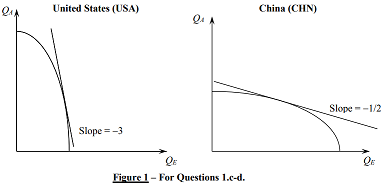
c. Based on the diagrams in Figure 1 (see next page), which country has the comparative advantage in which good? How do you know? Explain!
d. If there is free trade between USA and CHN, how will the two countries specialize (which country will export which good)? Draw the free trade equilibrium on diagrams like Figure 1, and demonstrate the consumer "gains from trade" using indifference curves. You do not have to give any specific quantities, but you must show a feasible number for the world relative price (terms of trade), (PE/PA)World, represented by the slope of a world price line or trading line on the diagrams.
e. Then, draw the export supply and import demand curves for electronic devices on a diagram similar to Figure 2 (next page), and show how the "world" relative price (PE/PA)World is determined with free trade. Be sure to indicate the vertical intercepts of the two curves and which country is associated with each one; you can use the number for the equilibrium (PE/PA)World that you made up for part d.
f. Draw the curves representing the factor-intensity ratios for high-skilled labor in producing the two goods (HE/LE and HA/LA) as functions of the relative wage of high-skilled workers (WH/WL). Which one is further to the right, HE/LE or HA/LA? Why? (Optionally, support your reasoning by showing the underlying isoquant and isocost diagrams).
g. On a separate diagram of this type for each country, show the economy-wide average relative demand (RD) for skilled labor and indicate which way it shifts in each country as a result of trade (and briefly explain why it shifts that way). What is the predicted impact of trade on the relative wage WH/WL in USA? in China? Do you think the distribution of income will become more equal or more unequal in each country, as a result of trade?
h. Which groups (L and H workers in each country) do you expect to gain and which ones to lose as a result of free trade, according to this model? To support your answer:
i. Analyze what happens to real wages for each kind of worker in terms of each good (WH/PE, WH/PA, WL/PE, and WL/PA) using the relevant marginal productivities of high-skilled and less-skilled labor (MPH and MPL for E and A). State which theorem you are applying here.
ii. Also show the direction of change in the ratios in the following equation, which equates the relative supply of the factors to the relative demand:
H-/L = (HE/LE)·(LE/L-) + (HA/LA)·(LA/L-)
Do the factor intensities (HE/LE) and (HA/LA) move in the same direction, or opposite directions, as a result of trade in the two countries? Explain how this is possible.
iii. Do these gains and losses depend on which industry the workers are employed in? Do they depend on which good each type of worker consumes more of? Why or why not?

2. Look at Figure 4-6 in the Feenstra & Taylor text, page 103 of the 4th edition (if you don't have the 4th edition, see slide 39 of the class presentation on the Heckscher-Ohlin model). According to these data, which factors of production is the United States abundant in? Which factors is it scarce in? Which factors are abundant and which ones are scarce in China, Japan, India, and Germany? How do you know? (Hint: read the text, or see slide 38 of the presentation for the criteria you should use!)
a. How do these findings change when we adjust the factor supplies for productivity differences, and use "effective" factor supplies ["endowments"] instead? Discuss with reference to the same countries, but only the two factors "R&D scientists" and "arable land" as shown in Figure 4-7, page 106) [slide 42 of the class presentation]. What are the most notable differences between actual and effective factor abundance for these two factors in these five countries (US, China, Japan, India, Germany)?
3. Thinking question: If there are net gains to a country from trade but some groups in society lose, could the winners compensate the losers and still preserve the overall (aggregate) gains? Is there any mechanism in the "free market" system to make this happen? If not, how could it be done? What are the practical and ethical issues involved in deciding whether this should be done?