Ask Macroeconomics Expert

ENVIRONMENTAL ECONOMICS Project - Environmental Regulation and Policies

Exercise 1: Academic Paper

Consider the two academic papers on the course website which you can find under the link "Project 2". If your student number ends on an even number, you are assigned: "Do Greens Drive Hummers or Hybrids?"; if your student number ends on an odd number, you are assigned: "Information As Regulation".

Read your assigned paper carefully and then summarize the paper in your own words in the following format: one page; single-space; font-size: 12; font-style: Arial. Your summary may be guided by the following questions:

What is the main topic of your paper?

What are the questions asked by the author(s)?

Why are these questions interesting and important?

How do the author(s) address these questions, i.e. which methodology is used?

What are the main findings, conclusions or thesis of your paper?

Are there other academic papers on the same topic mentioned in your paper?

What is your opinion about the paper?

Exercise 2: Emissions Trading I

Two identical firms save money from polluting. A firm's marginal savings from emitting an amount e are given by 20 - 3e.

a. If firm 1 is given two emission permits and firm 2 is given four emission permits and they are allowed to trade, how many permits will each firm end up with and what will be the permit price in equilibrium.

b. If instead each firm is given two pollution permits and trading takes place, how much will each firm end up emitting and what will be the permit price in equilibrium?

c. Compare the permit prices in equilibrium in (a) and (b) and explain the intuition.

Exercise 3: Emissions Trading II

The two firms shown below both emit carbon dioxide residuals into the atmosphere. Their respective Marginal Savings (MS) from pollution are shown below. Both firms have been given 15 tradable carbon permits that allow them to emit 15 tons of carbon dioxide each.
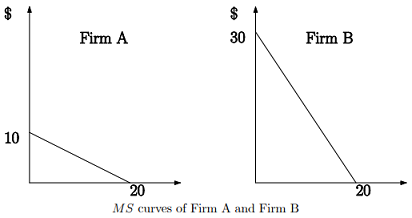
2281_figure.png

a. Determine the individual MS functions for these two firms.

b. Initially, each firm must use its 15 permits to reduce its emissions and they are not allowed to trade carbon permits. Illustrate the reduction each firm will make in carbon emissions. How much will each firm pay for abatement?

c. Suppose the two firms are now allowed to trade (buy and sell) carbon permits. Which firm will buy permits and which firm will sell permits and how many permits will be traded between the firms? Why will they take this action?

d. What will be the equilibrium permit price in this market?

Exercise 4: Regulation with unknown Control Costs

Suppose the total cost of controlling the pollution in Toronto is given by TC = (3 + r)q2, where q is the amount of emissions controlled. Uncontrolled, there would be 2 units of emissions in Toronto (e.g. 2 bn tons of CO2). Thus q = 2 - e, where e is emissions. The variable r is unknown to the government of Ontario which wants to regulate the emissions in Toronto. All they know is that it could take the value of either r = 0 or r = 4 with equal likelihood. Marginal damage from emissions is given by MD(e) = 4e.

a. Write the total cost of pollution control in terms of e. Graph this total cost as a function of e.

b. In this model, what could r stand for? Could you come up with some examples? Please explain.

c. Graph the marginal damages from emissions and the expected value (i.e., average over the two possible rs) of the marginal savings from emissions. Be as accurate as you can.

d. What level of emission fee or emission permit should be chosen, not knowing what value r will take? Show your answer on the graph.

e. Suppose after you have set the fee or permit in part (d) it turns out that r = 4. Show the deadweight loss from the permit and fee, assuming these instruments cannot be changed. Which instrument appears to be better?

Do only 2 and 3 questions.

Macroeconomics, Economics

  • Category:- Macroeconomics
  • Reference No.:- M92764122

Have any Question?


Related Questions in Macroeconomics

Economics assignment -topic evaluation of macroeconomic

Economics Assignment - Topic: Evaluation of Macroeconomic performance of Australia and New Zealand. Task Details: Complete a research-based analysis and evaluation of the relative macroeconomic performance of Australia a ...

Introductory economics assignment -three problem-solving

Introductory Economics Assignment - Three Problem-Solving Questions. Question 1 - Australia and Canada have a free trade agreement in which, Australia exports beef to Canada. a. Draw a graph and use it to explain and ill ...

Question in an effort to move the economy out of a

Question: In an effort to move the economy out of a recession, the federal government would engage in expansionary economic policies. Respond to the following points in your paper on the actions the government would take ...

Question are shareholders residual claimants in a publicly

Question: Are shareholders residual claimants in a publicly traded corporation? Why or why not? In some industries, like hospitals, for-profit producers compete with nonprofit ones. Who is the residual claimant in a nonp ...

Discussion questionsquestion 1 what are the main reasons

Discussion Questions Question 1: What are the main reasons why Nigerians living in extreme poverty? Justify. ( 7) Question 2: Why GDP per capita wouldn't be an accurate measure of the welfare of the average Nigerian? Exp ...

Question according to the definition a perfectly

Question: According to the definition, a perfectly competitive firm cannot affect the market price by any changing only its own output. Producer No. 27 in problem 2 decides to experiment by producing only 8 units. a. Wha ...

Question jones is one of 100000 corn farmers in a perfectly

Question: Jones is one of 100,000 corn farmers in a perfectly competitive market. What will happen to the price she can charge if: a. The rental price on all farmland increases as urbanization turns increasing amounts of ...

Question good x is produced in a perfectly competitive

Question: Good X is produced in a perfectly competitive market using a single input, Y, which is itself also supplied by a perfectly competitive industry. If the government imposes a price ceiling on Y, what happens to t ...

Question pepsico produces both a cola and a major brand of

Question: PepsiCo produces both a cola and a major brand of potato chips. Coca-Cola produces only drinks. When might it make sense for PepsiCo to divest its potato chip operations? For Coca-Cola to begin manufacturing sn ...

Question again demand is qd 32 - 15p and supply is qs -20

Question: Again, demand is QD = 32 - 1.5P and supply is QS = -20 + 2.5P. Now, however, buyers and sellers have transaction costs of $2 and $3 per unit, respectively. Compare the equilibrium values with those you calculat ...

  • 4,153,160 Questions Asked
  • 13,132 Experts
  • 2,558,936 Questions Answered

Ask Experts for help!!

Looking for Assignment Help?

Start excelling in your Courses, Get help with Assignment

Write us your full requirement for evaluation and you will receive response within 20 minutes turnaround time.

Ask Now Help with Problems, Get a Best Answer

Why might a bank avoid the use of interest rate swaps even

Why might a bank avoid the use of interest rate swaps, even when the institution is exposed to significant interest rate

Describe the difference between zero coupon bonds and

Describe the difference between zero coupon bonds and coupon bonds. Under what conditions will a coupon bond sell at a p

Compute the present value of an annuity of 880 per year

Compute the present value of an annuity of $ 880 per year for 16 years, given a discount rate of 6 percent per annum. As

Compute the present value of an 1150 payment made in ten

Compute the present value of an $1,150 payment made in ten years when the discount rate is 12 percent. (Do not round int

Compute the present value of an annuity of 699 per year

Compute the present value of an annuity of $ 699 per year for 19 years, given a discount rate of 6 percent per annum. As